
Bloomberg Law's Complaint Summaries
Designed an one-click GenAI solution that resulted on Bloomberg Law's highest traffic page.
01 — The Overview
My Role:
I designed a one-click AI-powered product experience on Bloomberg’s Law most-use page, helping litigators save non-billable hours reading long, detailed documents. An example how a small change can make big impact.
I was the sole Product Designer on this feature. I spoke to several legal experts and designed the GenAI product enhancement on the Bloomberg Law’s docket sheet.
I included the analytics teams from the partnered with PMs, SMEs, and engineers on technical feasibility and scope.
Outcome:
1000+ active users within 60 days
Copied summaries 128%+, signaling attorneys were using summaries in their actual work, not just clicking to see what it did.
Team members:
Principal Product Manager (licensed lawyer)
3 Engineers
02 — The Problem
Litigators rely on complaints to orient themselves to a case, scanning for four things: legal precedents, opposing arguments, possible outcomes and supporting evidence. However, these long, dense documents take time to read that they cannot bill for.
03 — Constraints
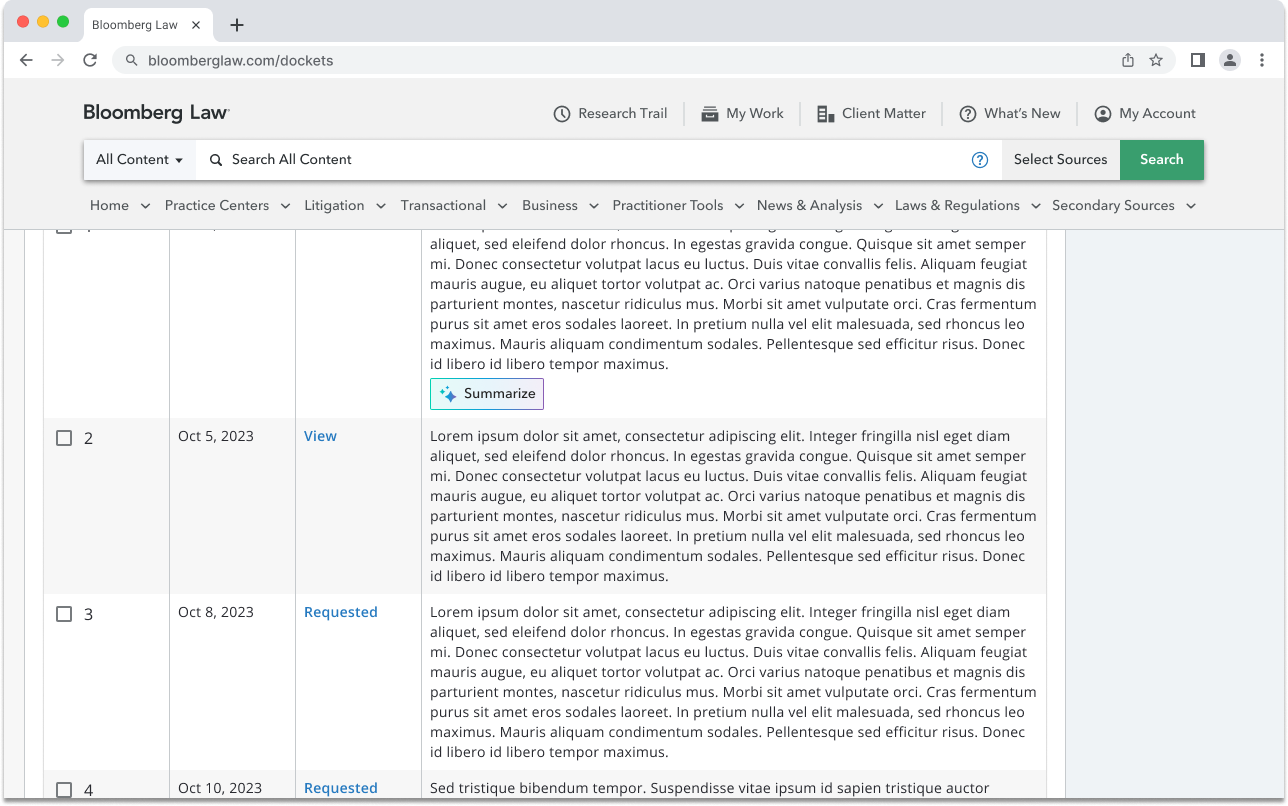
The summary couldn't ask attorneys to go somewhere new. It had to appear where they already were, surface only what they needed, and get out of the way.
IMAGE-BASED PDFS TOOK TOO LONG TO PROCESS
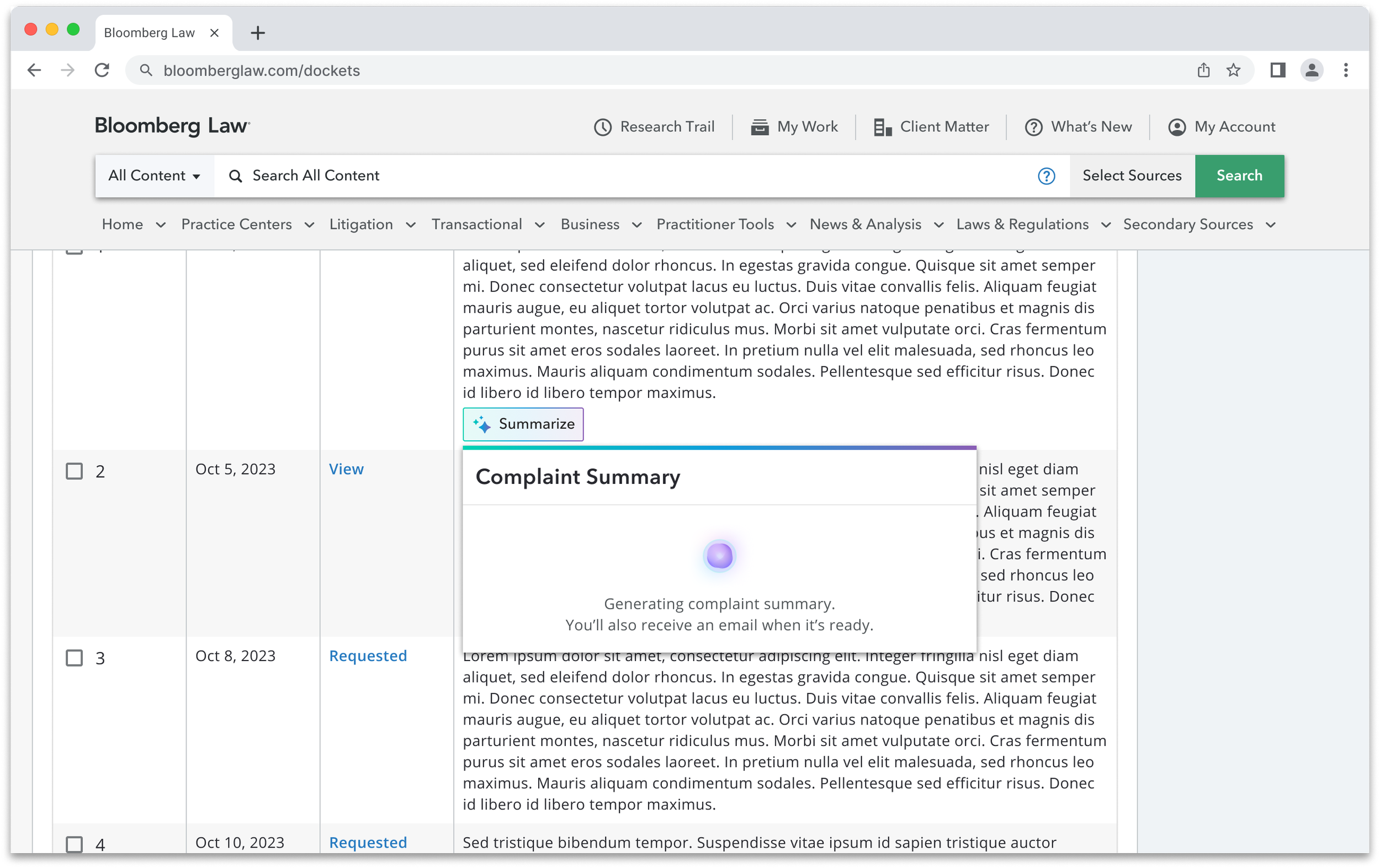
The AI model generated summaries from text-based PDFs in under 5 seconds. Image-based files were a different story — 30 minutes to process, on average. Keeping a user on the page for 30 minutes while a summary generated wasn't a UX problem. It was a broken product.
The solution was a non-disruptive fallback state for image-based files, paired with a shift to pre-generation for live summaries. Pre-generation kept attorneys on the page and eliminated the wait entirely for the most common document types.
THE DOCKET SHEET WASN’T OURS TO REDESIGN
The docket sheet, Bloomberg Law's most-used page, organizes case events in a rigid table with action buttons awkwardly positioned in the middle of each row. My recommendation was to move the button column to the end of the row, which would have aligned with standard UI patterns and made summary integration cleaner. However, engineering flagged rebuilding the table’s structure as high-effort, low-priority. So we designed around the constraint instead of fighting it, integrating the GenAI complaint summaries within the existing table structure.
04 — The Outcome and Results
The feature launched to production and the adoption numbers were clear.
1000+ active users within 60 days of launch
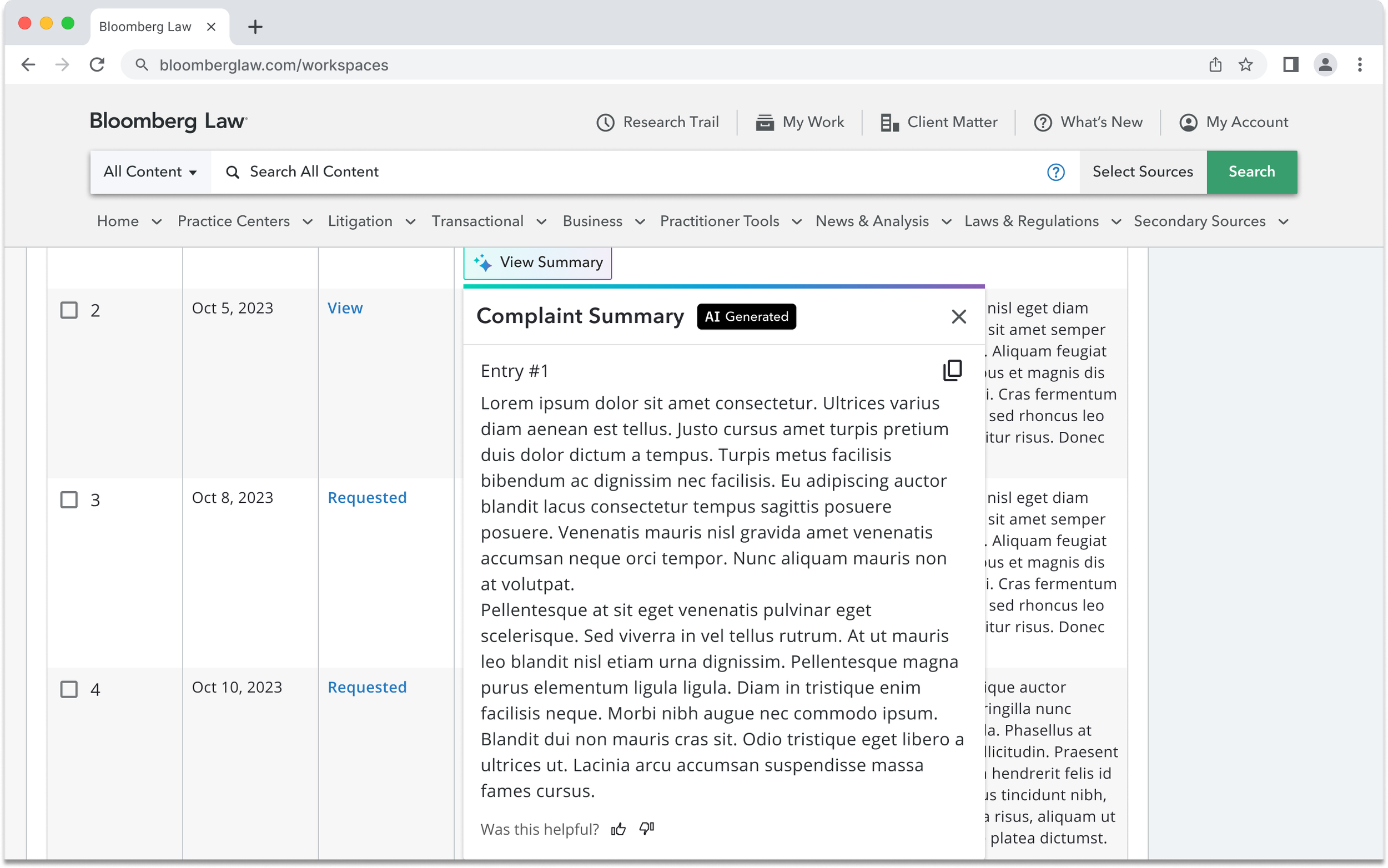
Copy actions up 128% — attorneys weren't just reading summaries, they were taking them somewhere. That's practical usage, not curiosity.
Pre-generation replaced live summaries based on performance data, keeping users on the page and improving perceived speed
The meaningful metric: Summary views tell you people clicked. Copy actions tell you people found it useful enough to use in their work. That's the difference between adoption and engagement.
SCREEN 01 · THE START
SCREEN 02 · THE PRELOADER
SCREEN 03 · THE SUMMARY
Next: See how I simplified complex financial scenario modeling for enterprise tax teams