01 — The Overview
This was my first blank-slate opportunity, designing a full product experience for tax professionals from the ground up. The original direction centered on a manual scenario builder, but customer conversations revealed a bigger opportunity.
Collaborating with the PM, we shifted course and designed a tax planning engine that replaced fragile spreadsheets with a system that automatically generates all permutations and helps teams finalize their tax strategy.
Product
Bloomberg Tax Fixed Assets
Team
- Product Designer (myself)
- Product Manager
- Tax Data Analyst as Subject Matter Expert
02 — The Problem
Corporate tax teams had no reliable way to model depreciation scenarios at scale.
Without a purpose-built tool, they were forced to manually build fragile spreadsheets in Excel, a time-consuming, error-prone process that limited them to evaluating only a handful of strategies at a time.
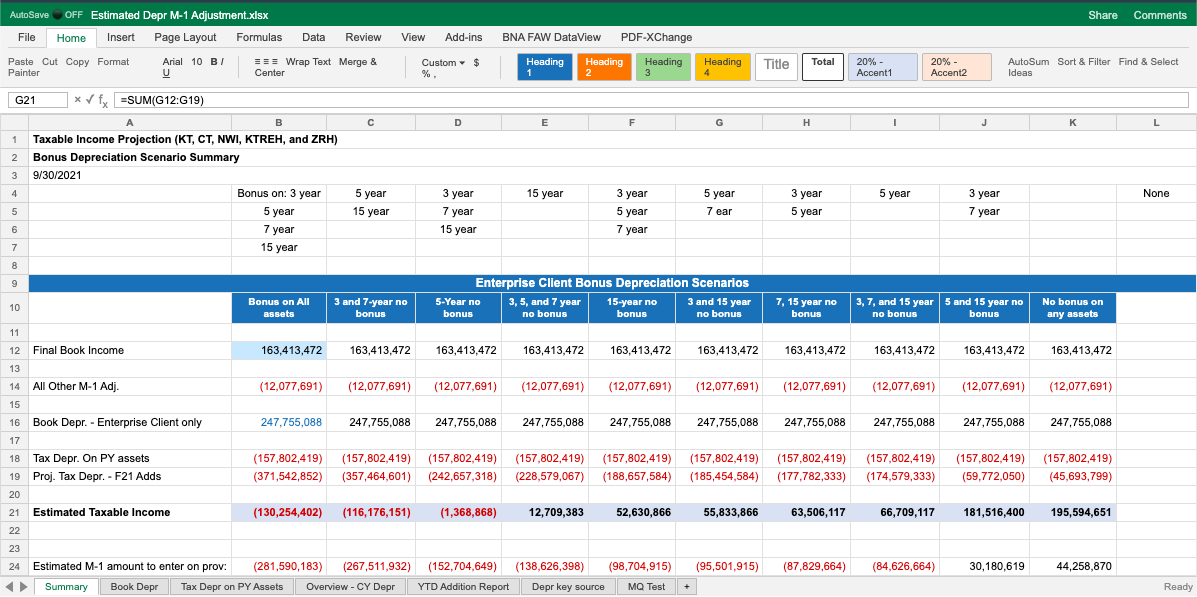
The stakes were high. Tax depreciation is one of the most consequential calculations a corporate tax team makes, involving thousands of assets, multiple election types, proposed regulatory changes, and year-end deadlines that leave no room for error. Getting it wrong isn't just inefficient. It's expensive.
And the person asking for the answers, the CFO, typically wanted multiple strategies, each of which could take weeks to prepare.
03 — The Research
What four enterprise customers told us
Excel is error-proned
Teams exported data, manually built strategies, and hoped they hadn't introduced an error somewhere in the process..
Asset inventory never stops changing
Enterprise customers acquire hundreds of thousands of assets within a single tax year. Every new acquisition meant recalculating depreciation scenarios from scratch.
The CFO drives the strategy, not the tax team
When we asked why teams chose bonus versus non-bonus elections, the answer was consistent: the CFO requests multiple strategies and the tax team prepares them. That preparation, building each scenario manually, was taking weeks. Teams couldn't share more detail because the specifics were company sensitive, but the time cost was clear.
04 — The Pivot
The PM was convinced the scenario builder was the right direction. I wasn't.
The original product direction was a scenario builder. Set your parameters, toggle your assumptions, generate a result. Repeat as needed. It was a reasonable response to what customers asked for, the ability to adjust sub-calculations without starting from scratch each time.
ChatGPT had just emerged. Microsoft CoPilot was on the horizon. I knew that a tool asking tax professionals to manually construct scenarios one at a time would have a shelf life of less than a year. I brought this argument to the PM. It took multiple conversations.
Alignment Moment
If we build a manual builder, we're solving yesterday's problem. If we build a system that generates every possible strategy automatically, we're building something CoPilot can't easily replace, because the value isn't the AI, it's the relief and confidence we can deliver to tax professionals. She came around. We changed direction.
05 — The Insight
32 isn't a guess. It's math.
Tax depreciation planning has a finite combinatorial structure. There are five asset class lives. Each class life has two election types: bonus and non-bonus. The total number of possible depreciation strategies equals 2 to the power of 5, which is 32 permutations.
Every enterprise tax team was evaluating a subset of those 32 strategies manually. We could generate all of them instantly. The design question stopped being how do we help tax professionals build scenarios. It became how do we help them navigate 32 strategies and arrive at the right one.
06 — Exploring Design Directions
From builder to browser
The first iteration followed the original PM direction, a manual scenario builder where users set parameters and generated results one at a time. It solved the stated problem. It didn't solve the real one.
Pivot Moment
Research findings revealed tax professionals are overwhelmed crunching numbers. They didn't need another tool that asked them to construct scenarios and create tables. The planning engine replaced it entirely, generating all 32 permutations automatically and surfacing them in a clean comparison interface.
Old Process vs New Process
07 — Concept Testing
The manual builder asked them to know the answer before they started. The planning engine let them find it.
We ran four concept testing sessions with 2+ tax professionals per session, 8+ tax professionals in total. The response was consistent: the ability to view and explore all permutations at once, and enter a target depreciation total to filter toward a decision, was exactly what teams needed but hadn't known to ask for.
08 — The Outcome
30+ hours saved. And they already knew what they wanted next.
Results
- Starbucks saved 30+ hours of Excel spreadsheet work in the first month
- Amazon adopted the planning engine for CFO strategy preparation
Their follow-up request: the ability to model the depreciation impact of future asset acquisitions before they happen. That became the foundation for the next product iteration.
09 — Metrics
Measured Impact
40%
Modeling activation rate among enterprise accounts
30+
Hours of manual spreadsheet work saved per month at Starbucks alone
83%
Plans exported, signaling users found a strategy confident enough to share with leadership
4.3K
Monthly visitors since Dec 2024, with a sustained spike beginning Jan 2026
24.5%
Activation rate across all subscription levels
0.00%
Friction and error rate. Zero error-inducing moments across all tracked sessions
1.2K
Monthly active users — enterprise tax professionals with high-stakes decisions
55–75%
Retention stabilizing after month 6 — users returning consistently post-onboarding
Source: Amplitude · BTAX Fixed Assets · Modeling Feature Adoption Metrics · Dec 2024 – Jun 2026